DOJ Faces Dismissal Bid in Alaska Election Case Over Dual Sullivan Candidates
Federal attorneys argue ballot confusion could delay certification, while challengers claim the legal theory is flawed.
By Justin Brooks ·
The Department of Justice is fighting a steep legal battle in federal court, attempting to prove that identical candidate names in Alaska could delay the certification of Senate election results. The government filed a lawsuit roughly two weeks before the Oct. 22 general election. The suit seeks a hold on certification if Senator Dan Sullivan loses and votes for a different candidate, Daniel J. Sullivan, might have altered the outcome. The core issue is whether voters mistakenly selected the wrong individual due to name similarity.
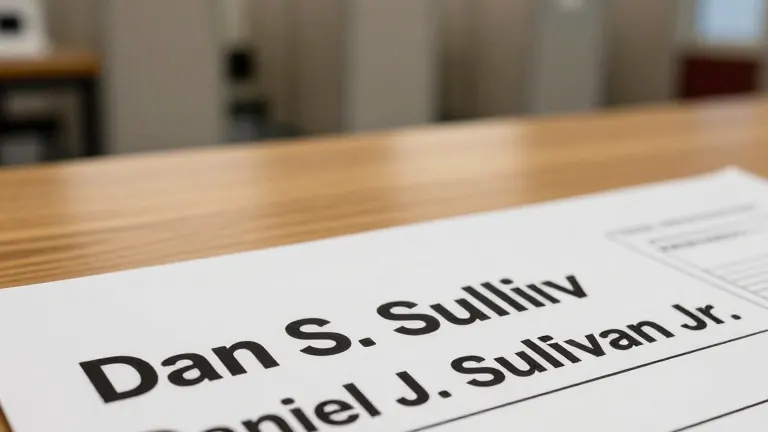
The legal dispute stems from the presence of two Dan Sullivans on the Alaska ballot. One is the incumbent Republican senator, listed as Sullivan, Dan S. The other is a retired schoolteacher, listed as Sullivan, Daniel J. Jr. The DOJ claims this proximity on the ballot risks confusing voters. The agency wants to investigate potential errors before the final results are locked in. This race carries national weight as Republicans work to maintain their slim Senate majority.
On Sunday, the campaign of Democrat Mary Peltola and the Democratic Senatorial Campaign Committee filed a motion to dismiss the DOJ lawsuit. They argue the federal law cited by the Justice Department governs voter registration, not candidate eligibility or ballot design. The challengers also asked the court to resolve the matter before Election Day. This move puts the DOJ’s legal theory under immediate scrutiny from the losing party’s legal team.
The New York Times reported on Wednesday that Peltola’s campaign worked with operatives to recruit the second Dan Sullivan. The goal was to create voter confusion that might draw support away from the incumbent. The Times cited interviews, text messages, and documents prepared for a potential lawsuit. The Peltola campaign has repeatedly denied involvement in the schoolteacher’s candidacy despite these reports. This background adds a layer of strategic intent to the name overlap on the ballot.
Conservatives have long argued that similar names on a single ballot can lead to accidental votes for the wrong candidate. Opponents counter that sharing a name with an incumbent is not enough to disqualify a candidate. They note that Alaska uses ranked-choice voting, which allows voters to list both candidates. This system may limit the impact of any mistaken selections. The state’s Division of Elections initially disqualified the schoolteacher, claiming his bid was not in good faith. Judge Thomas Matthews of the Alaska Superior Court overturned that decision in June. He ruled the Division lacked the authority to void the candidacy on that basis.
Attorney General Todd Blanche has suggested officials examine ranked-choice ballot patterns for signs of confusion. He told CNN’s Dana Bash that voters write multiple names on the ballot. Blanche said it could be obvious if a voter was confused by how they ranked the candidates. However, the Justice Department has not explained how these patterns would prove that individual voters made specific mistakes. Voter privacy protections make it difficult to link specific ballots to specific voters. This creates a major evidentiary hurdle for the federal case.
Notre Dame law professor Derek Muller described the DOJ’s plan as impossible to measure after the fact. He noted the difficulty of inferring voter intentions from anonymous ballots. Blanche later told CBS that the results and ballots would make the confusion obvious. He pointed to how voters rank the Dan Sullivans or omit them entirely. The DOJ’s strategy relies on statistical analysis rather than individual testimony. This approach faces skepticism from legal experts who favor traditional evidence standards.
Don Palmer, a senior legal fellow at the Heritage Foundation, believes the DOJ might have a case if constructed properly. He stated that statistical analysis alone will not convince a judge. Palmer said the campaign must use witness testimony, affidavits, and expert evidence to show enough voters were confused. A spokesman for the America First Policy Institute noted that voting for the non-Republican Sullivan as a first choice while ranking Republicans below could indicate confusion. Ben Hovland of the Center for American Progress was less optimistic about the DOJ’s prospects.
Hovland told Fox News Digital that no one has made a claim like this under the National Voter Registration Act. He called it a state ballot qualification issue. He suggested the DOJ is trying to sow doubt about the results. Walter Olson of the Cato Institute expects the state to beat Blanche in federal court. He believes the state will argue the issue is state law, not federal law. The DOJ did not respond to a request for comment on Tuesday.
Source: Fox News