Alaska Senate race hit by dispute over two candidates named Dan Sullivan
A New York Times investigation found the Peltola campaign recruited a retired teacher to split the Republican vote, prompting legal challenges from the state and federal government.
By Samantha Reed ·
Democrat Mary Peltola’s campaign recruited a retired teacher to run against her, aiming to confuse voters in the tight Alaska Senate race. A New York Times investigation published Wednesday revealed that members of the Peltola team approached Daniel J. Sullivan, a local educator, and convinced him to enter the contest. The move is known as ballot stacking and is designed to siphon votes from the incumbent Republican, Sen. Dan S. Sullivan, through voter confusion. The race is expected to determine which party controls the Senate for the remainder of President Donald Trump’s term.
The presence of two candidates with the same first and last name has triggered immediate legal and political backlash. On Thursday, the Alaska Republican governor launched a state investigation. The Department of Justice reportedly issued subpoenas for a criminal inquiry. The Trump administration had already filed a preemptive lawsuit challenging the election results. That suit alleged that the state should not certify the outcome if Senator Sullivan loses by a margin smaller than the number of votes cast for Mr. Sullivan. The Department of Justice later amended the complaint to claim the Peltola campaign lied in court documents.
Scott Kendall, an Alaska attorney who has worked in Republican politics, noted that no specific law appears to have been broken. He stated, “There’s no law on the books that’s violated by this conduct.” However, he added that the behavior could be unethical without being criminal, saying, “Something can be really, really lousy .. without being criminal conduct.” The controversy has raised the possibility of a civil or criminal case against the Peltola campaign less than a week before Election Day.
The state’s electoral process makes it easy for new candidates to appear on the ballot. The Division of Elections requires only that a candidate be a U.S. citizen, an Alaska resident, and over the age of 18. Libby Bakalar, a former assistant Alaska attorney general, explained that the agency typically does not look beyond these surface criteria. In this specific instance, however, the agency rejected Mr. Sullivan’s initial filing. It argued the candidacy was not in good faith and was filed to compromise the ballot’s neutrality.
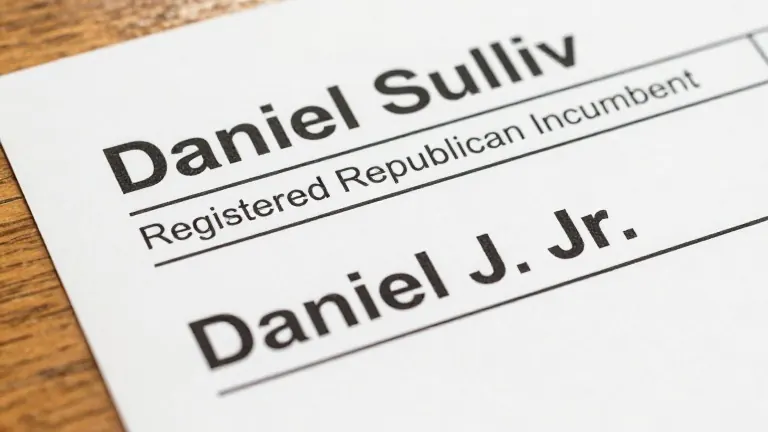
Mr. Sullivan appealed the rejection. In June, the Alaska Supreme Court ruled that the state had to include his name on the ballot. The Division of Elections subsequently altered the ballot language to clarify the candidates. It listed the incumbent as “Sullivan, Daniel S. (Registered Republican) Incumbent” and the challenger as “Sullivan, Daniel J. Jr.” with no party affiliation. Walter Olson, a senior fellow at the Cato Institute, said this informational remedy limits confusion without empowering courts to gatekeep who gets to run for office.
The Department of Justice filed its lawsuit on Oct. 23. Some legal experts argue the suit has a weak legal basis. They point out that no federal law overrides Alaska’s role in administering elections. The specific state law cited by the DOJ is a preamble, which is not legally binding. Rick Hasen, an election law expert at the University of California, Los Angeles, observed, “The Times story makes the Democrats look bad, but on the [DOJ lawsuit] it doesn’t make any difference.”
U.S. Sen. Lisa Murkowski, a Republican who endorsed Senator Sullivan, rejected the idea that lawful conduct is automatically acceptable. She wrote in a social media post that ballot stacking should have no place in the electoral process. She stated, “Alaskans deserve the honest truth from Mary and her campaign.” Other legal observers compare the maneuver to running an attack ad that mischaracterizes an opponent. Olson noted that all such tactics are fair game for reporting, allowing voters to decide for themselves.
Ms. Peltola denies knowing about the recruitment effort. Mr. Sullivan maintains he entered the race on his own accord. The New York Times report relied on text messages, emails, and an interview with a former Peltola campaign staffer to detail the recruitment. The dispute highlights the gap between what is legal and what many voters perceive as ethical. The election is scheduled for Nov. 3.
Source: The Christian Science Monitor