National report shows feral deer populations expanding across Australia
A leaked government assessment indicates most states are failing to control the invasive species, which cost the economy over $91m annually in 2025.
By Aiko Nakamura ·
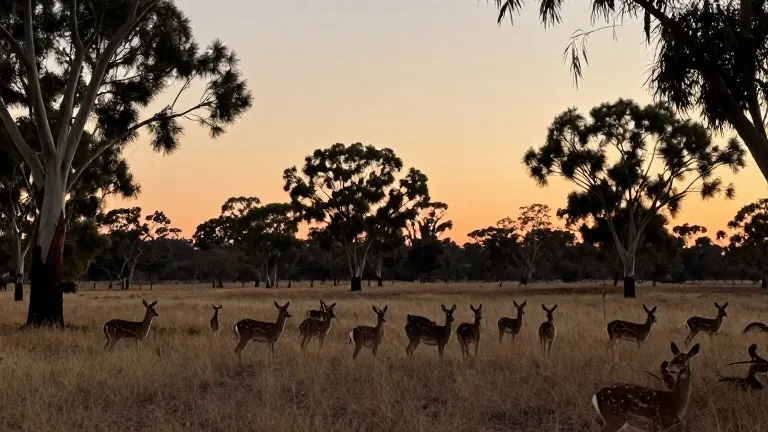
A new government assessment reveals that feral deer populations in Australia are growing and spreading, with most jurisdictions failing to contain the invasive species.
The report, produced by the National Vertebrate Pest Coordinators and covering the period from 2020 to 2025, describes deer as one of the country's most rapidly increasing invasive pests. It estimates that the animals cost more than $91m every year in production losses and management time. The data shows that deer densities are highest in south-eastern Australia, where six species are well established: chital, fallow, hog, red, rusa, and sambar. Smaller, localized populations exist in South Australia, Western Australia, and the Northern Territory.
The assessment uses a traffic light system to grade the performance of each state and territory. New South Wales and Tasmania received red ratings in all four categories. Queensland and the Australian Capital Territory each earned three reds and one yellow. No jurisdiction other than South Australia received a single green rating. This result suggests a widespread lack of effective management across the continent.
South Australia stands as the primary exception. The state launched a statewide eradication plan in 2022 and subsequently received green ratings in all categories. The report indicates that this effort successfully decreased the abundance, distribution, and environmental impact of deer in the region. Prof Andrew Lowe, director of the Environment Institute at Adelaide University, noted that the state has dealt with the issue earnestly since 2022. An agricultural impact estimate showed that deer caused $36m in annual damage in South Australia, a figure projected to reach $241m by 2031.
Lowe stated that a $4m eradication program began a few years ago, leading to a massive decline in deer numbers. However, he noted that the animals are now seeking refuge on the fringes of urban areas where culling is more expensive. He estimated that functional eradication in South Australia will require an additional $10m over the next decade. In contrast, he argued that inaction would allow the population to rebound, leading to costs comparable to the projected $241m.
Reece Pianta, advocacy manager for the Invasive Species Council, said the report confirms observations made by land managers for years. He described the situation as a long-term systemic underfunding of deer control. Pianta warned that deer could become Australia's next feral pig problem. He noted that while the animals likely cannot be eradicated from the entire continent, targeted interventions can contain or reverse their spread in specific regions.
Prof Euan Ritchie, president of the Australian Mammal Society, said he was not surprised by the findings. He stated that the report shows governments are failing to invest enough in controlling deer populations and their impacts on agriculture, native wildlife, and road safety. The report card was leaked to the Invasive Species Council, which has previously released footage showing feral deer activity in the Gold Coast.
Source: The Guardian