Auburn receives $6 million to help researchers test new ideas
The four-year grant funds a program designed to connect academic discoveries with market needs through prototypes and industry partnerships.
By Justin Brooks ·
Auburn University has secured a $6 million award from the National Science Foundation to support the transition of academic research into practical applications. The funding spans four years and is part of the NSF Accelerating Research Translation program, which assists universities in linking scientific work with real-world uses.
The initiative aims to create a supportive environment for faculty who wish to apply their findings outside the classroom. Steve Taylor, senior vice president for research and economic development, stated that the award will help strengthen the culture of innovation at Auburn. He noted that the goal is to ensure researchers feel supported as they move discoveries toward the market.
Patrick Reed, Auburn’s assistant vice president for innovation and partnerships, leads the effort. Reed explained that the program intends to build a lasting ecosystem for translational research. He said the initiative will allow faculty to do work at Auburn that they might previously have sought to do at other institutions.
The program involves faculty and administrators from the College of Sciences and Mathematics, Samuel Ginn College of Engineering, College of Agriculture, and Raymond J. Harbert College of Business. Co-principal investigators include Mark Liles, Allan David, and LaKami Baker. A key component is the Launch Innovation Fund, which provides up to $50,000 for proof-of-concept work and prototype development.
Reed emphasized that the process begins with determining who needs a specific technology and whether they will use it. He described a scenario where an academic investigator is deeply invested in a topic but needs to understand market feedback. Customer discovery sessions will help researchers decide if a technology is best suited for a startup, a licensing agreement, or an industry partnership.
LaKami Baker, a professor in the Harbert College of Business and certified I-Corps instructor, will lead the Faculty Venture Studio. This new studio will provide training, mentoring, and business research support. Baker said she aims to help faculty recognize the entrepreneurial potential and societal value of their research.
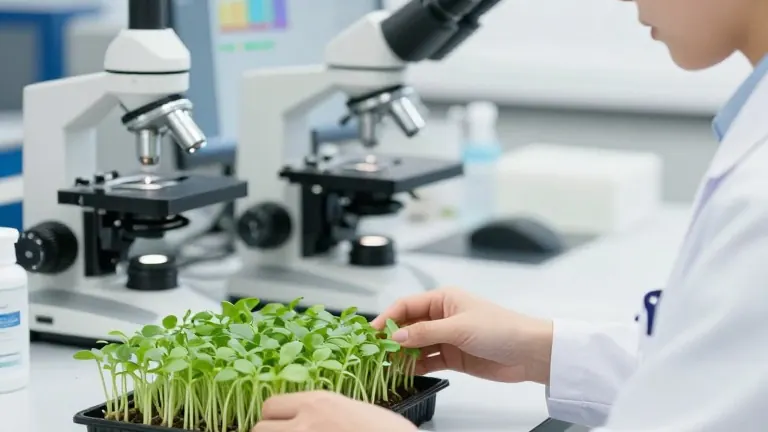
The first funded project under this grant involves a seed-treatment technology. Led by Liles, the project combines beneficial bacteria with a specialized pectin-based coating to protect plants against fungal disease. The team includes agriculture professors Alvaro Sanz Saez, Eros Francisco, and Zachary Noel, along with chemical engineering assistant professor Symone Alexander.
The naturally occurring bacteria act as probiotics for plants, helping crops defend against disease and potentially supporting growth. Liles said the work builds upon decades of Auburn research into plant-associated microbes, including the legacy of professor emeritus Joseph Kloepper. The team is currently testing the coating in the field and working with farmers to assess its resilience during drought.