300,000 visitors expected as Atacama Desert blooms in its largest recorded event
El Niño rains have triggered a massive floral display in Chile, prompting officials to seek UNESCO status and drawing record crowds to the arid coast.
By Samantha Reed ·
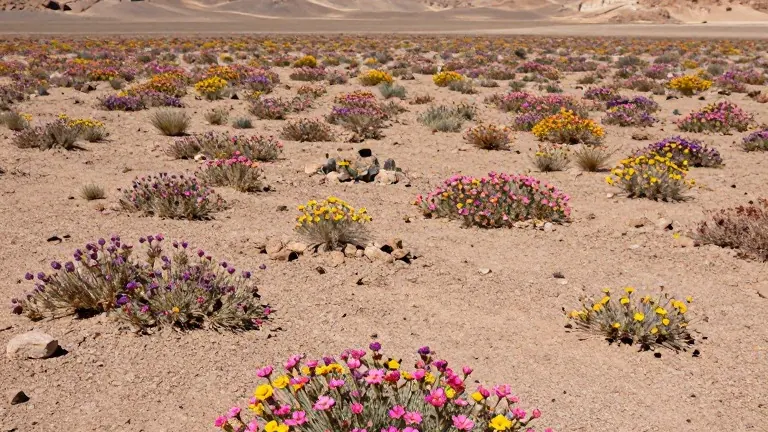
Chilean officials are preparing to request UNESCO World Heritage status for the Atacama Desert bloom, a move aimed at diversifying a regional economy that relies heavily on mining. The designation would make the site Chile's eighth World Heritage location, a goal Governor Miguel Vargas believes could position the region on the world stage.
The application follows the most extensive floral display seen in the driest nonpolar desert on Earth in the last three decades. Heavy rains associated with the El Niño super cycle brought flash floods to the Atacama in July and August, marking the heaviest precipitation recorded since the 1950s. While the floods destroyed or damaged dozens of homes and forced hundreds of residents to evacuate, the water also penetrated deep into the parched soil, activating a dormant seed bank.
The resulting bloom covers a vast area with pinks, yellows, and purples. More than 200 species are currently in flower, including the garra de león, a crimson endemic that grows along only a few miles of this specific coastline. Scientists have observed blooms in areas where flowers had never been recorded before, suggesting some bulbs lay dormant before detailed study of the phenomenon began in 1997.
The economic impact is already visible in Llanos de Challe National Park, a 113,000-acre area along the arid coastline. The park typically hosts about 10,000 visitors annually, but it has received 15,000 tourists in the last few weeks alone. Chile's national tourism board projects the region will see approximately 300,000 overnight trips during the two-month flowering season.
Moisés Grimberg, the administrator of Llanos de Challe, describes the event as a race against time. The biological window allows these species to complete their life cycle in roughly two to three months. He notes that the rain has transformed a natural seed bank into a living archive, waking plants that had waited for the right conditions for decades.
Researchers from INIA, Chile's national seed bank, are collecting specimens to analyze in northern laboratories before the season ends. Ana Sandoval, a biologist with INIA, explained that the desert is not devoid of life but waiting for precipitation to awaken it. Her team is working to preserve the genetic material and unique adaptations these plants have developed to survive extreme arid conditions, such as waxy cuticles and fine hairs that help harvest water.
The bloom supports a temporary ecosystem where insects hatch and attract lizards, bats, and guanacos. The phenomenon, which occurs every few years, is becoming more frequent due to climate changes that bring unseasonal rains. This year's flowering is projected to last until mid-November, leaving scientists to determine if it was the largest event on record and if it contains previously unknown species.